
Logo on Notebook: The Ultimate Guide to Stand-Out Branding
Ever received a piece of branded merchandise that felt… forgettable? A cheap pen that breaks, a flimsy tote bag? Now, imagine handing someone a high-quality, custom notebook with your logo elegantly debossed on the cover. It’s not just a giveaway; it’s a statement. This guide will walk you through transforming a simple notebook into a powerful marketing tool that keeps your brand in hand and top-of-mind, day after day.
Why a Logo on a Notebook is Your Smartest Marketing Move
In a world saturated with digital ads and fleeting social media posts, something you can actually hold in your hands cuts through the noise. A custom notebook with your logo offers a tangible connection to your brand that an email just can't match. It's genuinely useful, which means people appreciate it, and that positive feeling gets attached to your brand. Every time they jot down a note or sketch an idea, your logo is right there.
This isn’t just a hunch. The global notebook market was valued at around USD 20 billion in 2023 and is expected to keep climbing, driven by businesses seeking promotional items that actually work. A quick look at our collection shows you just how effective and affordable they can be.
Whether your brand is vibrant and modern or classic and professional, the versatility of custom notebooks makes them a reliable choice for any marketing campaign.
The Power of a Physical Connection
A branded notebook is more than just a giveaway; it's a strategic asset. Unlike a digital ad that vanishes in a split second, a notebook has a long lifespan, sitting on desks and traveling to meetings for months. This constant, low-key presence is incredible for building brand recall.
Here’s why it works so well:
- Boosts Brand Recognition: Daily visibility makes your logo impossible to forget.
- Strengthens Relationships: Gifting a quality notebook shows you value your clients and team.
- Cost-Effective Marketing: Notebooks offer one of the lowest costs per impression in promotional marketing.
Think of it this way: when you put your logo on a notebook, you’re creating a mobile billboard that travels everywhere with your audience. It’s a smart investment in visibility that pays off in brand awareness and customer loyalty. For more ideas, check out our guide on how to increase brand awareness.
Step 1: Picking the Perfect Notebook for Your Logo
Before you customize, you need a canvas. Choosing the right notebook is the first big decision that shapes how people see your brand. A sleek tech company might opt for a minimalist leatherette journal, while a vibrant creative agency could choose a full-color spiral-bound notebook. The material, size, and style all tell a story.
Match the Material to Your Brand's Vibe
The cover is the first thing people see and touch, making it a powerful branding element. Each material has a distinct feel and works best with certain customization methods.
- Classic Hardcover: Sturdy and professional, this is a great backdrop for any branding technique, from screen printing to foil stamping. It screams quality and reliability.
- Premium Leatherette (PU Leather): For a touch of class without the cost of real leather, this material is perfect for elegant debossing or a sharp foil stamp.
- Eco-Friendly Cork or Recycled Materials: If sustainability is a core value, an eco-conscious material instantly communicates that. A cork cover has a unique, earthy texture that looks amazing with a simple logo.
Your notebook material sets the tone. A premium cover can elevate a simple logo, while a creative material makes a bold design pop. The goal is a seamless experience where the notebook feels like a genuine part of your brand.
Think About How It Will Actually Be Used
Looks matter, but a great branded notebook must be useful. Practicality ensures daily use, keeping your brand top-of-mind. This is where size is key. The A5 size (5.8 x 8.3 inches) is the most popular choice for good reason. It’s large enough for serious note-taking yet small enough to toss in a bag. Of course, a pocket-sized A6 is great for field notes, while a larger A4 is perfect for desk planning.
Ultimately, you want to pick a notebook that people will actually want to use. A good first step is to explore a wide variety of custom notebooks and personalized journals to see what options spark an idea for your brand.
Step 2: Getting Your Logo on the Notebook Perfectly
You’ve picked the perfect notebook. Now for the fun part: making it unmistakably yours. The method you use to apply your logo is just as important as the notebook itself—it transforms a blank canvas into a powerful brand statement. Is your brand bold and modern, or classic and understated? The right technique will feel cohesive and look great.
If you’re still weighing your material options, this decision tree can help align the product with your brand’s vibe.
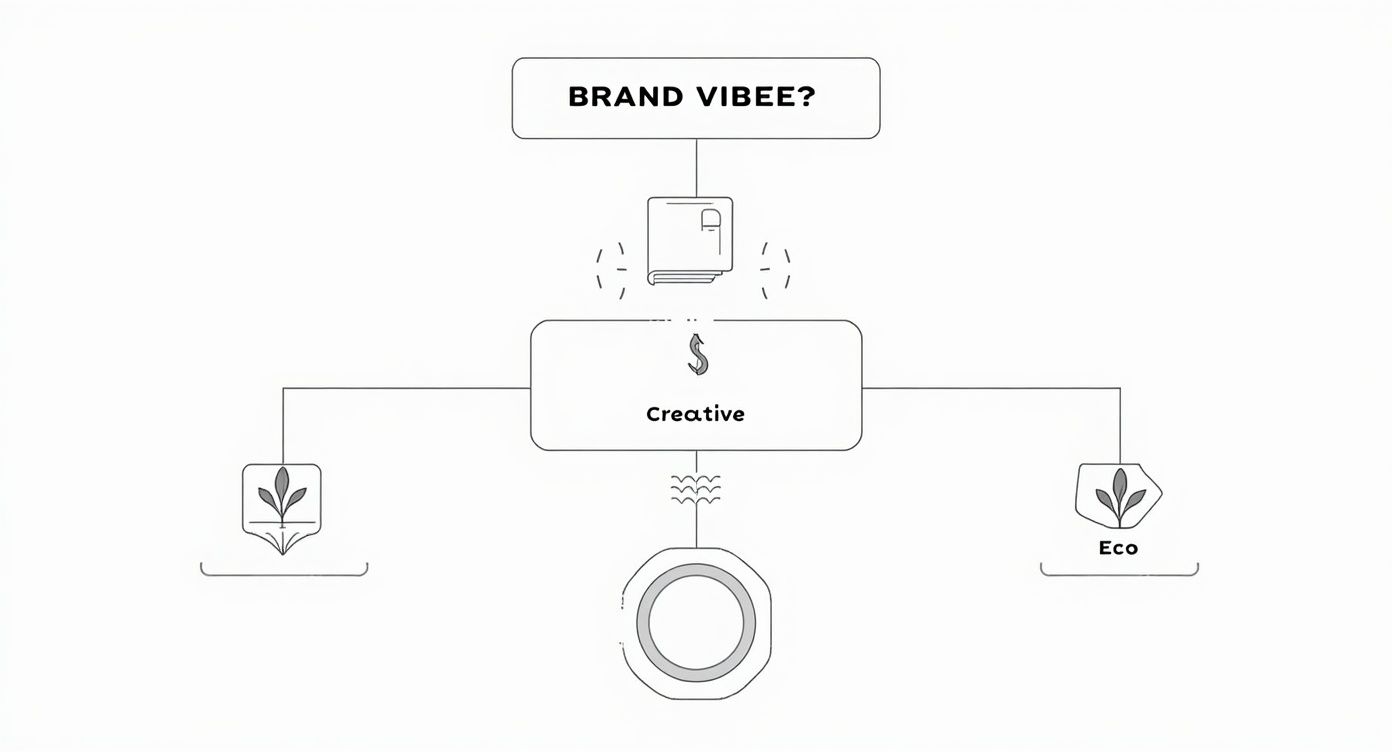
Choosing a material that reflects your values—be it luxury, creativity, or sustainability—is the foundation for making a lasting impression.
For Logos That Pop: A Look at Printing
When your brand identity is built on color and detail, printing is your best bet for bringing vibrant, complex designs to life.
- Screen Printing: This time-tested technique is brilliant for logos with one or two solid colours. It creates a bright, slightly raised finish that’s durable and cost-effective for large orders.
- Digital (UV) Printing: For logos with gradients, photos, or multiple colours, digital printing is the champion. It applies ink directly to the notebook for a crisp, full-colour, photorealistic logo that resists scratches and fading. We discuss similar principles in our guide on logo printing on ceramic mugs.
For a Touch of Class: Debossing and Foiling
For an elegant, premium feel, you’ll want a method that adds a tactile element and screams quality.
- Debossing: A perennial favourite, debossing uses a custom metal die to press your logo into the cover, leaving a subtle, sunken impression. It’s perfect for leatherette or soft-touch hardcover notebooks, creating a minimalist, sophisticated look.
- Foil Stamping: This technique uses heat and pressure to apply a thin layer of metallic or coloured foil to the cover. It creates a brilliant, reflective finish that stands out, especially on darker notebooks, adding a layer of luxury.
Expert Tip: A standard deboss is "blind" (colourless), but you can elevate it with "foil debossing," which fills the indentation with metallic foil for a pop of shine combined with that classic, tactile feel.
Branding Methods at a Glance
| Method | Best For | Look & Feel | Logo Complexity | Cost-Effectiveness |
|---|---|---|---|---|
| Screen Printing | Simple, bold logos (1-2 colours) on large orders. | Vibrant, slightly raised, durable ink finish. | Low | Excellent for high volumes. |
| Digital (UV) Printing | Full-colour, complex, or photorealistic logos. | Sharp, smooth, scratch-resistant, flat finish. | High | Great for any order size with complex art. |
| Debossing | Elegant, minimalist branding on premium materials. | Subtle, indented, tactile, and sophisticated. | Low to Medium | Mid-range, due to die creation cost. |
| Foil Stamping | Adding a luxurious, metallic shine to any logo. | Bright, reflective, eye-catching, and premium. | Low to Medium | Mid-to-high range, adds perceived value. |
Step 3: Preparing Your Artwork for a Flawless Finish
A brilliant notebook design can fall flat if the artwork file isn’t right. Getting your logo ready for print is the difference between a crisp, professional finish and a blurry, expensive mistake.
The single most important factor is your file type. For putting a logo on a notebook, a vector file is always the best choice. Formats like .AI, .EPS, or .SVG are built from mathematical lines, not pixels, meaning your logo will stay perfectly sharp at any size.
While vector is the gold standard, a high-resolution raster file (like a .PNG) can work for digital printing if it’s at least 300 DPI (dots per inch) at the final print size.
Key Technical Checks for Your Logo File
Run through these quick checks to avoid common production hiccups:
- Convert Text to Outlines: If your logo includes text, turning it into a solid shape locks the font in place and prevents substitution errors.
- Use the Right Color Mode: For precise color matching, provide Pantone (PMS) codes. For full-color digital printing, ensure your file is in CMYK mode, not RGB, to avoid color shifts.
Getting these technical details right from the start saves time, avoids back-and-forth emails, and prevents extra costs associated with file correction.
Adapting Your Design for Different Methods
Not every logo works for every method out of the box. A complex, multi-color logo will need to be simplified for a one-color method like debossing.
- Mind the Gaps: For foiling and debossing, ensure lines and spaces are thick enough so they don’t fill in or disappear.
- Simplify Intricate Details: Fine textures often don't translate well when stamped. Focus on the strongest, most recognizable parts of your logo.
- Think in One Color: Convert your logo to solid black. If it’s still recognizable, you’ve identified its essential elements.
These principles of clean design apply to most promotional products. You can find more insights in our guide with promotional pens ordering tips for maximum impact.
Step 4: Balancing Your Budget and Eco-Conscious Choices
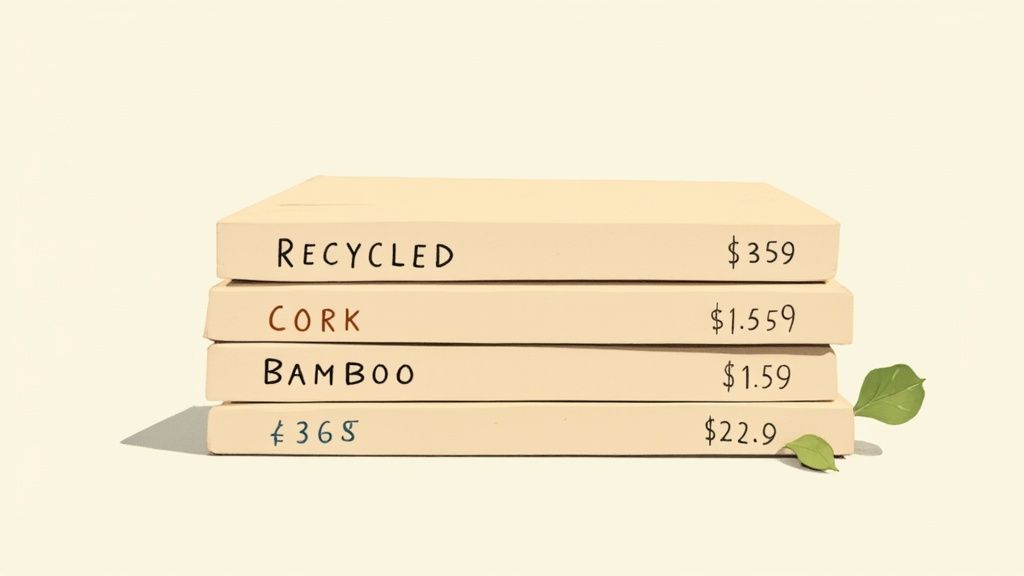
When planning your custom notebook order, it’s not just about the price per unit; it's about finding value. The branding method is a huge factor: a single-colour screen print is cost-effective, while foil debossing requires a custom die, increasing the price. Likewise, a standard hardcover notebook has a different price point than one wrapped in premium cork.
Making Sense of Minimum Order Quantities (MOQ)
The Minimum Order Quantity (MOQ) is the smallest order a supplier can run economically. Setting up a custom job has a fixed upfront cost. Spreading that fee across more notebooks lowers the price per unit. While ordering more saves money per item, don't order 1,000 if you only need 100. A smart strategy is to forecast your needs for the next 6-12 months and consolidate orders to hit a higher quantity tier.
Choosing to Go Green
Opting for an eco-friendly notebook is a powerful way to show what your brand stands for. Sustainable options today are stylish, high-quality, and more accessible than you might think.
- Recycled Paper: Made from post-consumer waste, reducing deforestation and landfill waste.
- Cork Covers: A renewable material harvested from oak tree bark without harming the tree.
- Bamboo Notebooks: A fast-growing, sustainable grass that creates a durable and unique cover.
When you choose sustainable materials, you make a public statement about your company's values. It shows clients you're committed to more than just the bottom line.
This shift toward sustainability is making waves. Projections show the global paper notebook market is expected to reach USD 76.28 billion by 2025, driven by demand for certified products. For more on eco-conscious marketing, see our guide on the environmental impact of promotional pens and sustainable solutions.
The Final Step: From Proof to Production
You’ve made your choices and sent your artwork. Now, it's all about ensuring the final product is exactly what you imagined. This process begins with a digital proof—the final dress rehearsal for your brand. It shows exactly how your logo will look, its size, and its placement.
The Final Check: Proofing and Timelines
When that proof lands in your inbox, scrutinize every detail. Is the logo perfectly centered? Is the scale right? Are the colors spot-on? This is your most important checkpoint. For large or high-budget orders, consider a physical sample to feel the texture of a deboss or see the shimmer of foil.
Once you approve the proof, production begins. Timelines vary by method:
- Printing (Screen & Digital): Typically 5-10 business days.
- Debossing & Foiling: Requires a custom die, so plan on 10-15 business days.
Pro Tip: These timeframes are for production only and don't include shipping. I always tell clients to build a buffer into their schedule, especially for an event deadline.
It's also worth noting that global trade policies can impact inventory. Planning your project in advance helps secure stock and lock in your timeline. For analysis on market forces, visit platforms like TrendForce.com.
Common Questions Answered
Let's tackle some of the most common questions about putting a logo on a notebook so you can finalize your order with confidence.
What’s the right file format for my logo?
A vector file (.AI, .EPS, or .SVG) is essential. Unlike pixel-based files (.JPG, .PNG), vectors are built from mathematical paths. This means we can scale your logo to any size and it will stay perfectly sharp and crisp. No blurriness, ever.
Debossing vs. Embossing: Which should I pick?
Both add a high-end, tactile feel, but they create different effects.
- Debossing presses your design into the cover for a subtle, indented impression. It's classic, premium, and by far the more common choice.
- Embossing raises the logo up from the surface for a more pronounced, 3D texture.
Think about the experience you want to create. Debossing is about subtle class, while embossing makes a bolder statement.
What’s the minimum order I can place?
Minimum Order Quantities (MOQs) depend on the notebook and customization method.
- For straightforward printing, we can often start with as few as 25-50 units.
- For more involved processes like debossing or foil stamping, the minimum is typically around 100 units due to the custom setup costs.
Summary: Your Perfect Branded Notebook Awaits
Putting your logo on a notebook is a powerful way to create a lasting brand connection. By choosing the right notebook, selecting a branding method that reflects your style, and preparing your artwork correctly, you can create a promotional item that people will genuinely value and use daily. From classic hardcover notebooks with a simple screen print to premium leatherette journals with an elegant deboss, the options are limitless.
Ready to create a notebook that makes a lasting impression?
The team at Persopens lives and breathes this stuff, and we’re here to guide you through every detail.


