

Ever seen a splash of Tiffany blue or heard the Intel chime and instantly known the brand? That's not magic; it's the power of a deliberate, well-crafted brand identity. Forget thinking of it as just a logo. Brand identity is the complete sensory experience a company creates—the sum of all the visual, verbal, and emotional cues that tell the world who you are, what you stand for, and why anyone should care.
It's the strategic face you present to your audience, turning your business from just another name in the crowd into a memorable, trusted presence. Ready to build an identity that sticks? Let's dive in.
Understanding Your Brand Identity: More Than a Logo
Think of your brand identity like a person's character. It’s not just their profile picture (the logo). It’s the way they speak (tone of voice), the clothes they wear (colour palette), and the values they live by. All these traits work together to make them recognisable and relatable. For your business, it’s the same—every element combines to create a cohesive and memorable experience for your customers.
This goes way beyond your logo. Your brand identity is the voice in your emails, the specific colour palette on your website, and even the feel of your business cards. Every single element is a piece of a larger puzzle, working together to communicate your story consistently.
Why a Holistic View Matters
It's a common mistake to think a logo and a colour scheme are the whole story. While they're definitely crucial, they are just single chapters. A strong brand identity is more like a strategic blueprint that guides every single interaction a customer has with your business. For a deeper dive, this guide to branding identity design for small businesses offers a fantastic look at its importance.
A well-defined identity creates consistency, and consistency builds trust. When your customers see the same fonts, colours, and messaging everywhere—from your website to your promotional products—they start to see your business as professional and reliable. This familiarity is what fosters real loyalty over time.
A strong brand identity is the foundation that turns a business into a memorable brand people connect with. It creates a consistent experience that translates directly into tangible promotional items.
Ultimately, this organised approach builds a cohesive and recognisable presence in a crowded market. It’s the foundation that turns a business into a brand people remember, connect with, and choose over the competition. You can explore how this translates into real-world items by learning more about https://persopens.com/blogs/insights/personalized-business-products that bring your identity to life.
The Core Elements of a Powerful Brand Identity
To build a strong brand identity, you need to master its core components. Think of it like a recipe: each ingredient plays a specific role, but it’s how you combine them that creates something truly memorable. These are the sensory building blocks that tell your brand's story without uttering a single word.
Each component, from your logo to the specific fonts you choose, plays its own unique role. When you combine them thoughtfully, they create a cohesive and memorable experience for your audience. This organised system makes sure every interaction, whether on your website or on a simple promotional pen, feels undeniably you.
This diagram shows how all these components fit together, branching out from the core identity to create both sensory and emotional experiences.
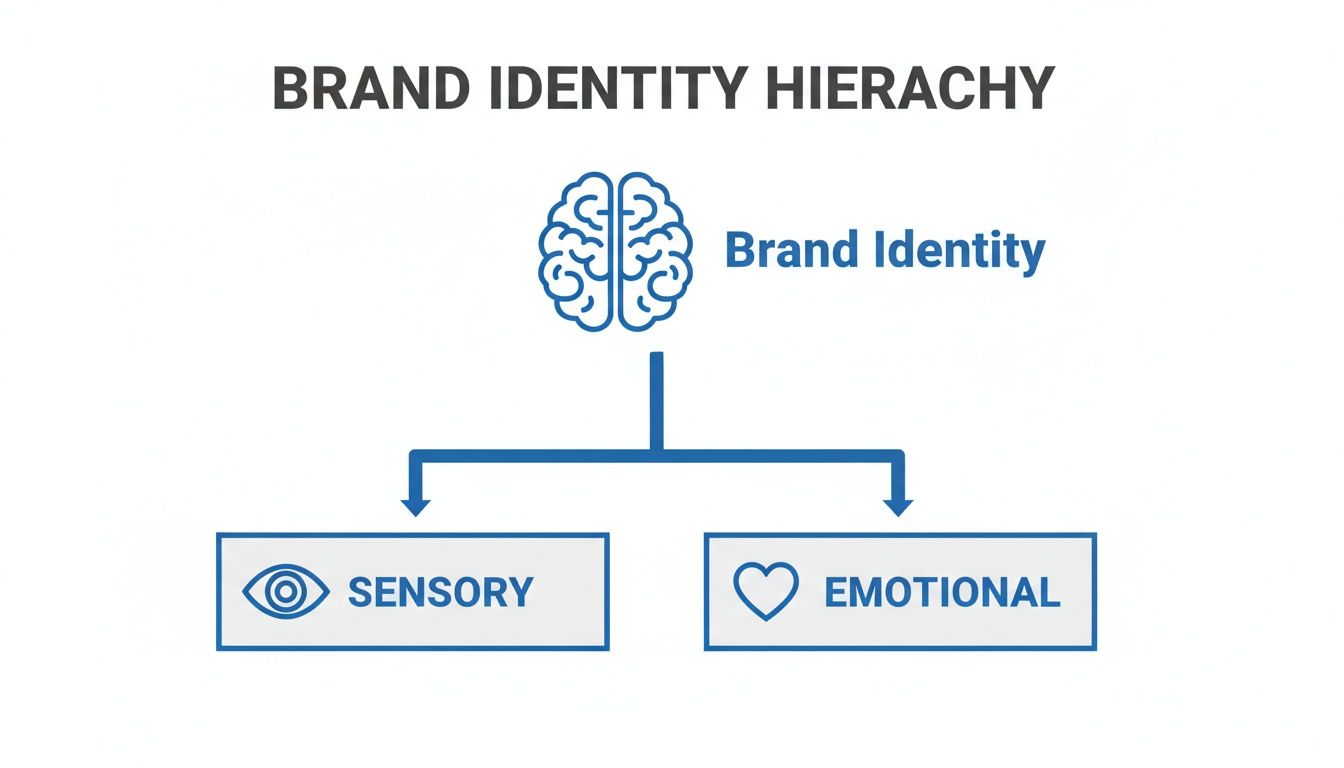
As you can see, a great brand identity appeals to what customers see (the sensory) and how it makes them feel (the emotional). That's how you forge a powerful connection.
Logo: The Face of Your Brand
Your logo is the most immediate, recognisable shortcut to your brand. It’s the visual anchor for your entire identity, appearing on everything from the tiny favicon in a browser tab to your official company letterhead. A well-designed logo should be simple, memorable, and versatile enough to look great whether it's embroidered on a shirt or displayed on a giant billboard.
Just think of Nike’s swoosh or Apple’s bitten apple. They're so powerful they don't even need the company name next to them anymore. That's the gold standard of instant recognition.
Colour Palette: The Mood Setter
Colour is a potent psychological tool. It triggers emotion and sets the tone for your brand faster than almost any other element. A consistent colour palette makes your brand instantly recognisable across every platform you use. In fact, research shows that sticking to a signature colour can boost brand recognition by up to 80%.
Think about the feelings different colours bring to mind:
- Blue: This often signals trust, security, and professionalism, which is why you see it so often with banks and tech companies.
- Red: It’s all about energy, passion, and excitement. Food and entertainment brands love it because it grabs attention.
- Green: This colour is deeply linked to nature, health, and sustainability, making it a natural choice for organic or eco-conscious brands.
Choosing your palette isn't just about picking colours you like; it’s a strategic move that shapes how people perceive you.
Typography: The Voice of Your Words
The fonts you choose—your typography—give your written words personality. Just like a person's handwriting can feel elegant, modern, or playful, so can your brand’s typography. The two main families are serif and sans-serif fonts.
Serif fonts (like Times New Roman) have small decorative strokes on the ends of the letters. They tend to feel traditional, reliable, and authoritative. In contrast, sans-serif fonts (like Arial or Helvetica) don't have these strokes, giving them a cleaner, more modern, and approachable vibe. This choice subtly guides how your audience reads and interprets your message.
Your brand identity is not just what you show, but how you communicate. Every font, colour, and image is a piece of a larger conversation with your customer, building a relationship based on consistency and trust.
This consistency is vital for building trust, especially in the UK market. Recent data shows that 26% of UK adults are more likely to trust a business if its branding feels familiar, and a quarter are more inclined to buy from them.
Tone of Voice: The Personality
If your visual elements are how your brand looks, your tone of voice is how it sounds. It’s the personality that comes through in all your communication, from social media posts to customer service emails. Is your brand witty and a bit cheeky? Or is it authoritative and formal?
A luxury car brand, for instance, would probably adopt a sophisticated and confident tone. A company that makes children's toys, on the other hand, would go for something fun and energetic. Defining this tone is crucial for keeping your brand’s personality consistent, which in turn builds a stronger relationship with your audience. You can see how this personality translates into physical products by exploring some of the best swag ideas.
Brand Identity vs Brand Image and Branding
In marketing, you'll often hear three terms used interchangeably: brand identity, brand image, and branding. While they're all connected, they mean very different things. Getting this right is about understanding what you control versus what you can only hope to influence.
Let's break it down with a simple analogy. Imagine you're getting ready for an important meeting. Your brand identity is the outfit you meticulously choose: the sharp suit, the polished shoes, the confident haircut. You control every single element to present a particular version of yourself. It's the tangible, visual, and verbal package you create.
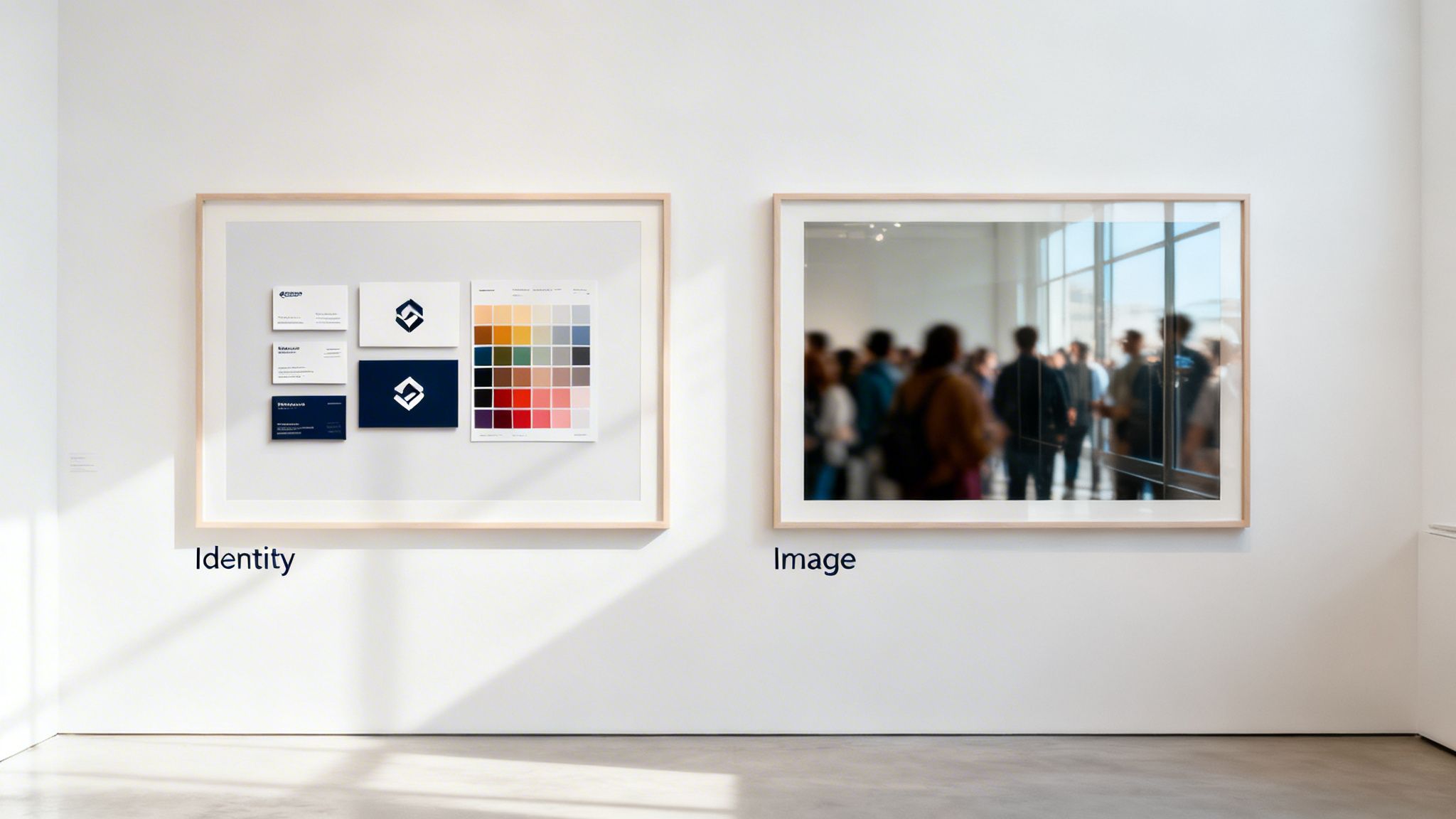
Now, your brand image is what everyone in that meeting actually thinks of your outfit. It’s their perception, their gut feeling about you based on what you’re wearing. You can’t get inside their heads and force them to see you a certain way, but that carefully chosen identity gives you a massive head start. Brand image is formed in the minds of your customers.
The Action That Connects Them
So, where does branding fit into all this? Branding is the action. It’s the continuous work of choosing the suit, getting the haircut, and showing up consistently, time and time again. It’s the verb—the strategic, ongoing process of using your brand identity to shape your brand image.
This distinction is actually quite empowering. While you can't force a customer to feel a certain way about your business, you have total control over the identity you build. By managing that identity with purpose, you actively steer public perception in the right direction.
Your brand identity is what you build. Your brand image is what people believe. Branding is the work you do to bring the two together.
Let’s lay it out one more time to make it stick:
- Brand Identity (Internal & Controlled): This is your toolkit—all the tangible elements you create to show the world who you are. We're talking logo, colour palette, typography, and tone of voice. It's your intentional self-expression.
- Brand Image (External & Perceived): This is the public's impression of you. It's shaped by every single interaction they have with your company, from an advert they see to a conversation with your support team. It’s your reputation.
- Branding (The Process): This is the active marketing work of applying your brand identity everywhere to influence your brand image. This consistent effort is a huge part of learning how to improve customer loyalty.
Getting your head around these differences is the first real step from just running a business to building a brand that lasts. It gives you a clear road map for every decision you make about how your company shows up in the world.
How a Cohesive Brand Identity Boosts Your Business
Putting effort into your brand identity isn’t just about looking good—it's a smart investment in your bottom line. When your identity is cohesive, it shapes how customers see you, trust you, and ultimately choose you over the competition. It’s a powerful engine for growth, turning perception into profit.
Imagine every customer touchpoint telling the same story. This creates a seamless, reliable experience that builds recognition. Think of a financial advisor whose polished brand appears on their website, their business cards, and even on client appreciation gifts like an engraved pen. That consistent presentation instantly signals professionalism and success, making potential clients feel they’re in safe hands.
Building Trust Through Consistency
Consistency is the fastest route to credibility. When your logo, colours, and tone of voice are the same everywhere, customers subconsciously learn to trust what you stand for. This predictability makes your business feel established and reliable, smoothing the path for them to make a purchase.
Each consistent interaction reinforces your brand’s promise, creating a stable presence in the customer's mind. It's this foundation of trust that transforms a one-time buyer into a loyal advocate. Getting this right is a crucial first step for anyone looking to learn how to increase brand awareness effectively.
A consistent brand is a trusted brand. When what customers see aligns with what they experience, you create a powerful bond of loyalty that competitors find difficult to break.
This trust has a direct financial impact. In the UK, a staggering 60% of consumers admit they would actively avoid a brand if its logo looked unprofessional or outdated. But the flip side is even more compelling: businesses that maintain brand consistency across all their platforms see an average revenue increase of 23%. If you want to dive into the numbers, you can read more about these logo statistics that will matter in 2025.
Driving Recognition and Differentiation
In a crowded marketplace, being memorable is everything. A strong brand identity makes you instantly recognisable, helping you cut through the noise and capture attention. When a customer can spot your brand from a distance—whether it’s on a social media feed or a promotional tote bag—you’ve already won half the battle.
This instant recognition pays off in several ways:
- It simplifies customer choice: When faced with too many options, people naturally gravitate towards the familiar. A recognisable brand is an easy choice.
- It reinforces your market position: A unique visual identity helps you stand out from the crowd and firmly claim your space in the industry.
- It boosts marketing effectiveness: Your campaigns land with much more impact when the audience already knows who you are and what you're about.
At the end of the day, a cohesive brand identity isn't just a "nice-to-have"—it's a fundamental business asset. It fosters the recognition, trust, and loyalty that lead directly to sustainable growth and a healthier bottom line.
Bringing Your Brand Identity to Life with Promotional Products
A strong brand identity can't just live on a screen or in a style guide. Its real power is unleashed when it steps into the real world. Think of promotional products as the bridge between your digital presence and your customers' daily lives. They make an abstract idea tangible, memorable, and genuinely useful, turning your brand into something people can hold, use, and connect with.
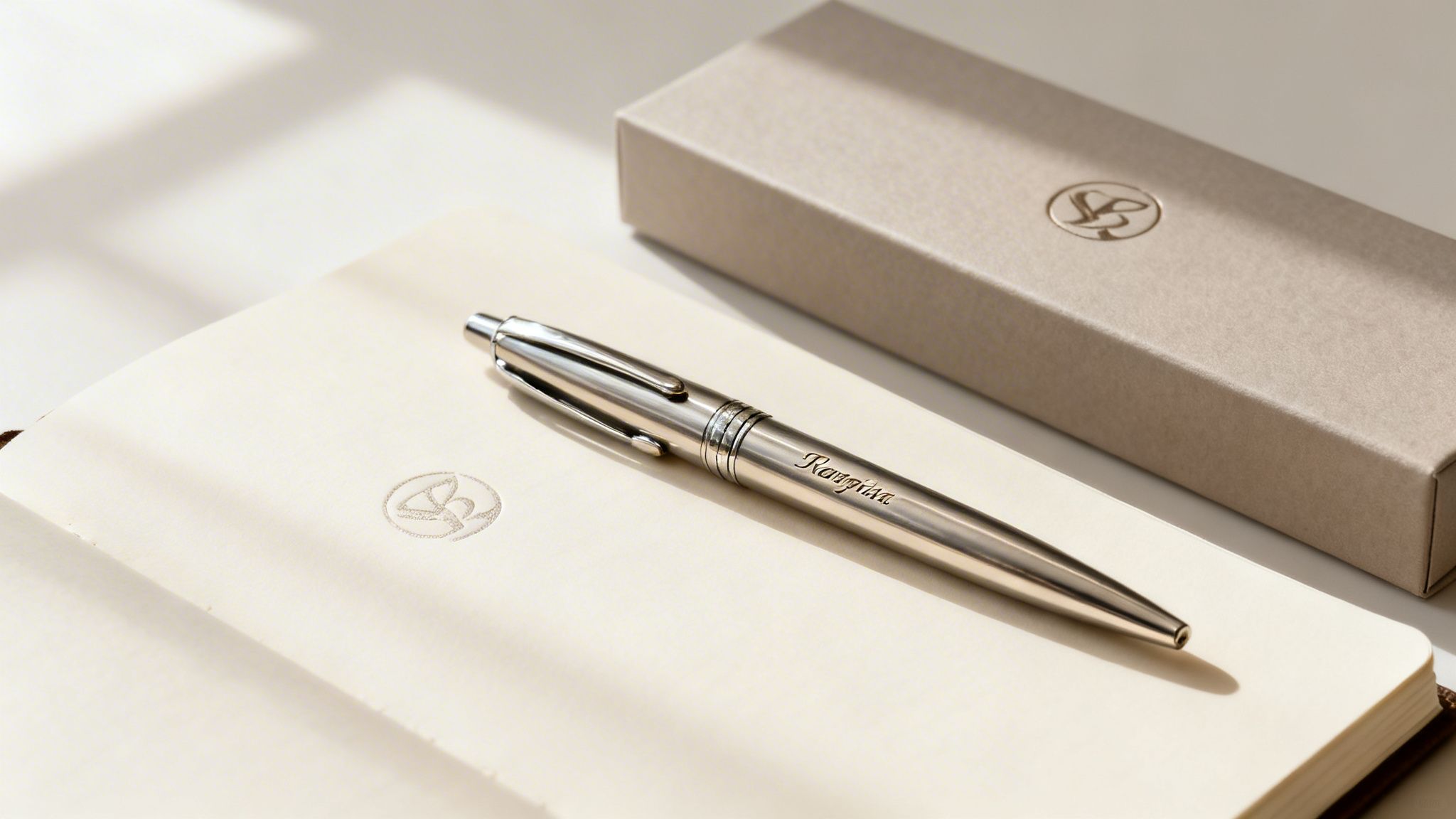
This is where your carefully chosen colours, logo, and tone of voice truly come alive. An elegant metal pen given as a corporate gift doesn't just write; it communicates sophistication and value. A vibrant, soft-touch pen handed out at a trade show says you're approachable and modern. These items become physical storytellers, reinforcing what your brand stands for with every single use.
The impact of well-chosen items is only growing. A quick look at Google Trends shows a huge spike in UK searches for ‘brand identity design uk’ towards the end of the year. This isn't a coincidence. It signals that businesses are gearing up for trade shows and new-year rebrands, which is the perfect time to get your event-ready promotional products sorted. You can see the full picture of branding trends in the UK on Accio.com.
Choosing Products That Tell Your Story
The secret to getting this right is picking items that actually feel like your brand. A mismatched product just creates confusion, but the right one amplifies your message tenfold. It's about being strategic, not just slapping a logo on the first thing you see.
Think about these real-world scenarios:
- Building Team Culture: New hire welcome kits with branded notebooks and quality pens instantly make employees feel they've joined a professional, organised team. It’s a small touch that says, "You belong here."
- Communicating Premium Value: An engraved metal keychain or a durable tote bag given to a high-value client acts as a lasting reminder of a quality partnership, long after the meeting has ended.
- Generating Buzz at Events: Eye-catching and genuinely useful items, like soft-touch gel pens or stylish water bottles, can make your booth the one everyone is talking about at a busy conference.
Every choice is another chance to strengthen your identity. For more ideas, have a look at our guide on how to select the best branded promotional items for your specific goals.
A Practical Checklist for Perfect Printing and Engraving
To make sure your promotional products look flawless, getting your artwork right is non-negotiable. A blurry logo or a colour that's slightly 'off' can completely undermine the professional image you're trying to build. Before you send your designs to a printer or engraver, run through this quick checklist. It’ll save you a lot of headaches and guarantee a perfect result.
A perfectly executed promotional product is a testament to a brand's attention to detail. Getting the technical aspects right ensures your physical brand identity is as sharp and professional as your digital one.
Follow these expert tips to prep your files for production:
- Submit Vector Files: Always provide your logo and artwork in a vector format like .AI, .EPS, or .SVG. Unlike pixel-based files (.JPEG, .PNG), vectors can be scaled to any size without losing quality, ensuring your logo looks crisp on everything from a pen clip to a banner.
- Use Pantone (PMS) Colour Codes: To guarantee colour accuracy, use the Pantone Matching System (PMS). Screen colours (RGB) and standard print colours (CMYK) can vary, but a PMS code ensures your signature blue looks like your signature blue, no matter what it's printed on.
- Outline All Fonts: Convert all text into outlines or curves before sending the file. This turns letters into vector shapes, so the printer doesn’t need your specific brand font installed, preventing unexpected font substitutions.
- Consider the Material and Method: Think about how your design will look on different surfaces. A complex logo that's stunning on a notebook may need to be simplified for engraving on a metal pen. Chat with your supplier about the best method—printing, engraving, or embossing—for the material.
Your Next Steps to a Stronger Brand Identity
We've covered the what, why, and how of brand identity—from its core elements like logos and colours to the crucial role of consistency. Think of this guide as your foundation for building a brand that not only gets noticed but gets remembered.
Remember, a powerful brand isn’t a one-time project; it’s an ongoing commitment. Every email, social media post, and branded item you share is an opportunity to reinforce who you are. This relentless consistency is what transforms a simple business into a brand that customers feel connected to.
Moving your identity from a screen into a physical object is where the magic happens. A promotional item that reflects your values isn't just a giveaway; it’s a tangible piece of your story that makes your brand useful and memorable in a way a digital ad can't. To keep the momentum going, digging into some practical small business branding tips can give you that extra edge.
Ready to bring your brand to life?
Explore our collections of high-quality promotional products and discover how easy it is to create a physical connection that your customers won't forget. Turn your brand identity into a lasting impression today.
Answering Your Brand Identity Questions
As you start putting these ideas into action, some questions will naturally pop up. Let's tackle a few of the most common ones.
How Often Should I Update My Brand Identity?
A full-scale rebrand is a huge deal, something most businesses only need to consider every 5-10 years. Think of it less like knocking down the house and more like a fresh coat of paint.
Most of the time, what you really need is a brand ‘refresh’. This means making small, smart tweaks to your logo, colour palette, or fonts. The goal is to stay current and relevant without confusing the people who already know and love you. It’s all about evolution, not revolution.
Can a Small Business Build a Strong Identity on a Tight Budget?
Yes, without a doubt. A powerful brand identity isn't about how much money you spend; it's about how consistent you are.
Start with the basics: nail down your core values and what your brand’s personality feels like. You can use affordable (or even free) design tools to create a professional-looking logo and pick a solid colour scheme. The real magic happens when you apply it everywhere. Your website, your social media posts, your business cards, even a simple, well-chosen promotional pen. Consistency costs nothing, but it builds recognition faster than any big-budget campaign.
What’s the Single Most Important Element of Brand Identity?
Everyone immediately points to the logo, and for good reason—it’s the face of your brand. But honestly, the most crucial element isn't one single piece. It's consistency.
A brilliant logo is useless if your colours are all over the place and your tone of voice changes from one day to the next. Think of your brand identity as an orchestra; the logo might be the lead violin, but the beautiful music only happens when every instrument plays in harmony.
When every element works together, every interaction a customer has with you reinforces the same story. That’s how you build a brand that people truly trust.


0 commenti